

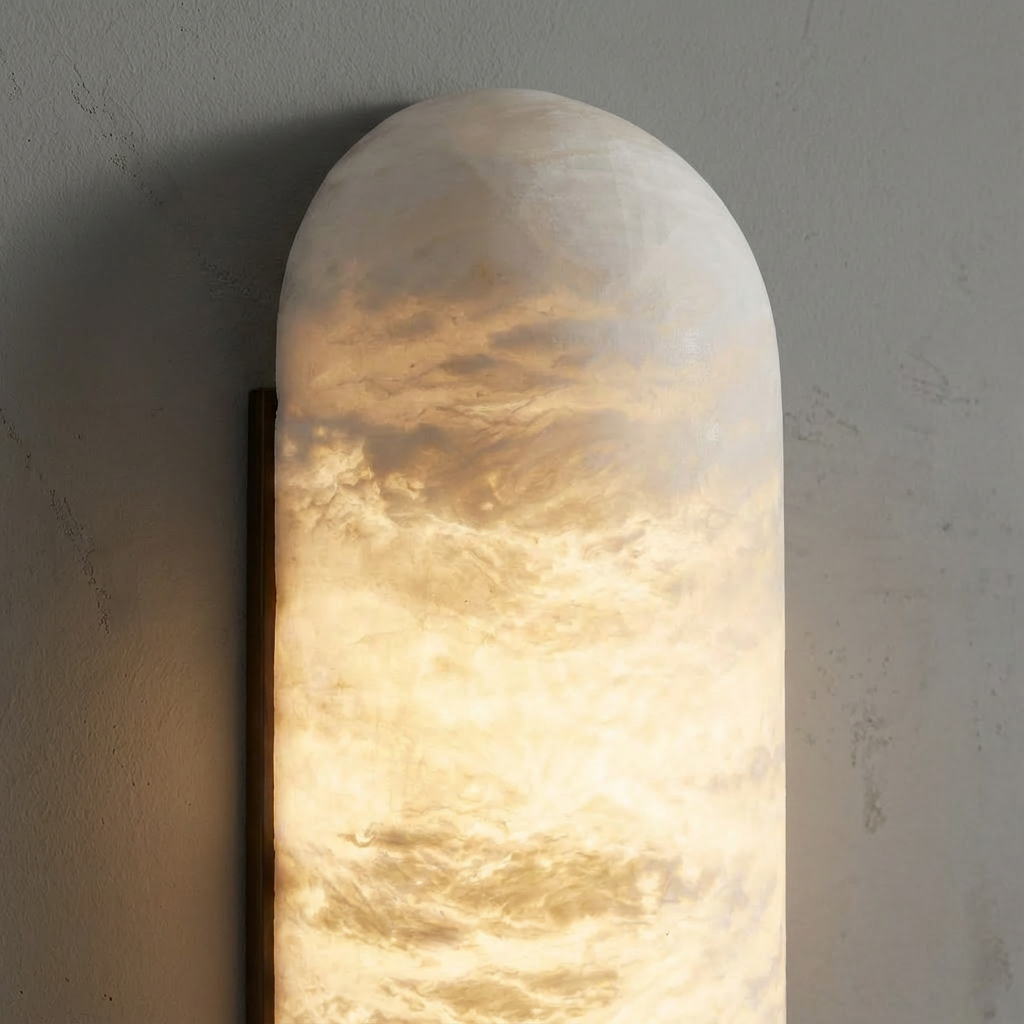
Alabaster is a natural stone formed slowly beneath the earth, shaped by pressure, mineral movement, and time. Its use in lighting is not ornamental by nature, but architectural — defined by material presence rather than surface effect.
Unlike glass or synthetic diffusers, alabaster carries depth and density. Each piece contains subtle veining, tonal variation, and natural opacity that cannot be standardized or replicated. These qualities are intrinsic to the stone itself.
When illuminated, alabaster behaves differently from transparent materials. Light passes through the stone gradually, diffusing as it travels. The result is a soft, even glow — calm rather than bright, ambient rather than directional. Importantly, the stone does not disappear when lit.
Because alabaster is a natural material, variation is unavoidable and essential. Veins may appear cloud-like or linear. Color ranges from warm white to pale ivory. These differences are not defects or inconsistencies, but the visual record of the stone’s formation.
Alabaster should not be confused with resin, acrylic, or glass alternatives. It is heavier, more substantial, and less uniform. Its translucency is inherent, not applied. Its surface is matte and stone-like. Over time, alabaster ages quietly, retaining its character.
In lighting, alabaster serves both functional and spatial roles. It softens light while anchoring a fixture visually, allowing illumination to feel integrated with the architecture of a space. The light belongs to the room, not to the fixture alone.
At AxisLumen, alabaster is used with restraint. Panels and shades are cut to preserve thickness, proportion, and natural veining. Selection prioritizes material integrity while remaining true to the stone’s nature.
Alabaster is not chosen for perfection.
It is chosen for presence.


